The $7 Audit That Killed
Our Backlink Budget
How a 28-year-old direct mail company out-cited three funded SEO agencies in AI search — and what actually moved the needle.
Results at a glance
51K
monthly impressions recovered from 7 broken pages
+21%
week-over-week clicks (May)
+31%
week-over-week impressions (May)
#2
AI citation rank vs. funded agency comparison set
Google Search Console · 12-month performance · crst.net
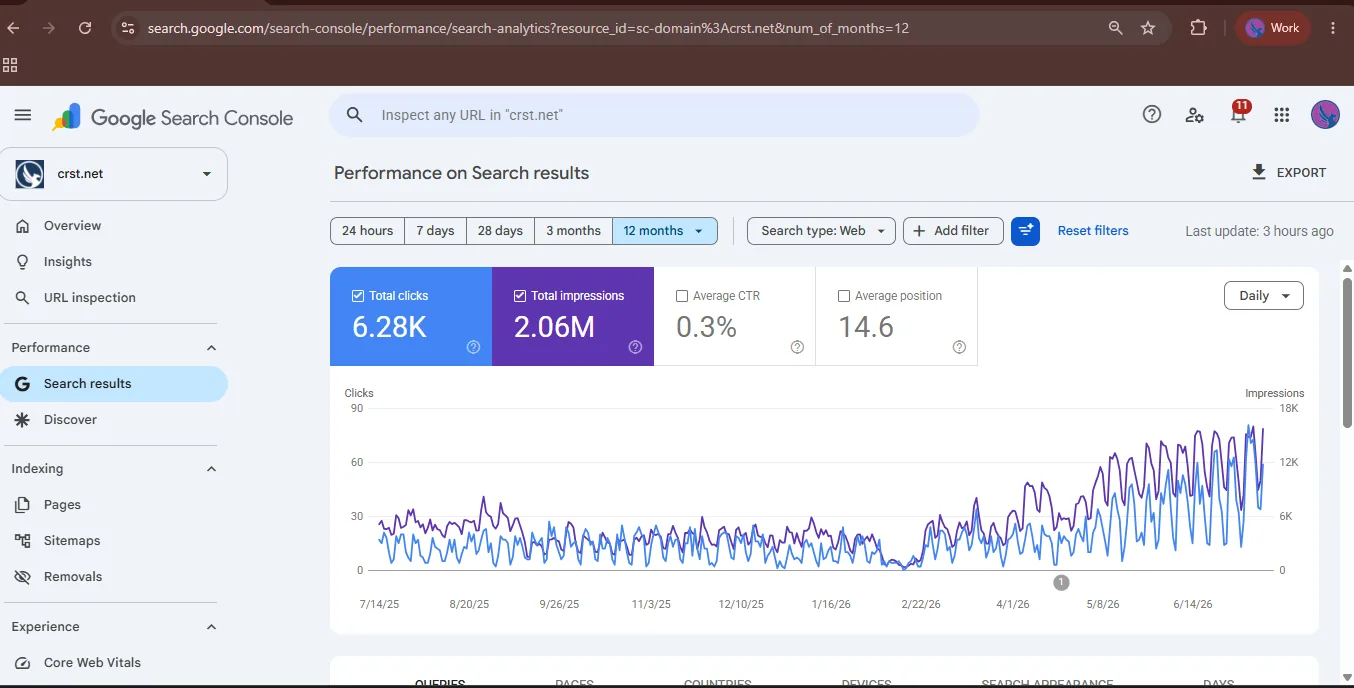
6.28K clicks · 2.06M impressions · avg. position 14.6 · 12-month window. Source: GSC, exported July 2026.
Starting position
An aging WordPress site with a 25-year reputation and almost no digital footprint to match it.
The rebuild to a static Astro site went live in February and, like every migration, it broke things before it fixed them:
- 601 URLs not indexed in GSC — 350 redirect chains, 86 hard 404s
- 99.5% of referring domains pointed at the homepage. Zero pointed at a service page.
- 76.6% branded anchor text, under 1% commercial
- Seven high-value legacy resource pages orphaned or redirecting to the wrong destination
- Blog living on a subdomain (
blog.crst.net) with no external authority
The obvious diagnosis was "we need links." That turned out to be wrong, and finding out it was wrong is the actual case study.
Phase 1 · ~$0.50
Retiring the backlink hypothesis
Ran a backlink gap analysis through DataForSEO against three direct competitors. Total API cost: about fifty cents.
| Metric | crst.net | Competitors |
|---|---|---|
| Referring domains | 231 | 49 – 70 |
| Rank 60+ links | 21 | fewer, all three |
The site already had 3–4× the referring domains of everyone it was losing to. Links were never the bottleneck. Distribution was — of anchor text, and of target URLs. Every ounce of authority was pooling on the homepage and going nowhere.
The fix cost nothing in outreach:
- Case study callouts injected into eight service pages, each with commercial anchor text
- A homepage paragraph linking to all seven service pages with keyword anchors
- A conversion callout added to the highest-traffic tool page (envelope sizes, ~58K impressions)
Internal authority redistribution instead of a link-building retainer. A $0.50 API call falsified a $2–5K/month assumption.
Phase 2
Recovering what was already earned
A URL-level GSC audit of the migration wreckage found seven legacy resource pages that were still pulling serious impressions while landing users on broken or wrong destinations.
416 clicks and 51,319 impressions/month recovered across those seven pages. The largest single one — a USPS nonprofit form walkthrough — was doing 295 clicks and 15,990 impressions a month while routing to the contact page. Rebuilt with the original screenshots, correct schema, and proper internal linking.
No new content. No new links. Just repairing what a migration had quietly severed.
Parallel cleanup: 166 toxic domains disavowed — cross-referenced between Semrush toxicity scores and GSC top-linking-sites data, which disagreed significantly. Worth checking both before you submit a disavow file.
Phase 3 · $7.04
The AI citation audit
Instead of guessing which questions matter in AI search, we mined them:
- Question discovery — People Also Ask + Google Autocomplete + AI Keyword Data via DataForSEO. Returned 100–300 demand-validated questions.
- Cut to 40 by AI search volume and buying intent.
- Citation mining — those 40 questions through the LLM Responses endpoint across ChatGPT and Gemini, extracting the full sources array from every answer. Output: 29,671 individual source citations. Total cost: $7.04.
Two findings changed the strategy:
Convergence is real and it's cheap
Split the 40 questions in half and compare the top-20 cited domains from each half — 15 of 20 overlapped. The citation landscape converges after roughly 40 well-chosen questions. Everything past that is spend without signal. You do not need to run 300 questions.
The domain ranked #2
Against the compared agency domains in that question set, crst.net came back second by citation frequency — a print and mail company outranking funded digital agencies in AI answers about SEO and marketing services. Not because of links, but because the site is dense with structured, factual, question-formatted content that models can extract cleanly.
Third finding, straight ad-copy fuel: "Is SEO dead?" carries 12,490 AI search volume, and ChatGPT answers it without citing sources. An open citation slot on the highest-anxiety question in the category.
Results
| Metric | Before | After |
|---|---|---|
| Recovered organic (7 pages) | broken / misrouted | 416 clicks, 51,319 impressions/mo |
| Weekly clicks (WoW, May) | — | +21% |
| Weekly impressions (WoW, May) | — | +31% |
| Referring domain distribution | 99.5% homepage | authority pushed to 8 service pages |
| AI citation rank (compared set) | untracked | #2 |
| Research spend, total | — | under $10 |
Sister project, same playbook — Environmental Forest Products (eforestproducts.com), rebuilt and relaunched April 18, 2026: 8× daily impressions, 3.4× daily clicks, 20-position average lift in the first 16-month comparison window.
What actually transferred
- 1
Verify the hypothesis before you fund it.
"We need backlinks" was a $2–5K/month assumption that a $0.50 API call falsified. The data said the links existed and were pointed at the wrong things.
- 2
Migrations leak earned traffic silently.
GSC's crawled-not-indexed count is mostly stale entries that self-heal — but buried inside it were 51K monthly impressions landing on the wrong page. URL-level, not summary-level.
- 3
AI citation share is measurable for the price of a sandwich.
Most people are guessing about AI visibility or paying for a monitoring subscription. Forty questions, two models, source arrays out, done.
- 4
Structure beats authority in AI answers.
Question-format H2s, a 1–2 sentence direct answer under each, FAQ schema with every Q&A visible in the DOM (no accordions — models don't click), specific numbers and dollar figures. That's what got a small regional printer cited above agencies with far more domain authority.
- 5
The moat is the human.
The site's information gain is Sean's 25 years in the business — the things you can't generate. AI-drafted content only works when it's carrying experiential knowledge captured from a person first, and when a credentialed name owns the byline.
Open questions I'm still working
for-{vertical}content clusters (eddm-for-gyms,eddm-for-dentists) — Google reads them as near-duplicate doorway pages and won't index them. Publishing stopped. Is there a version of programmatic vertical content that survives, or is the pattern dead?- Blog on a subdomain with no independent authority. Migrate to
/blogon root, or is the redirect risk worse than the ceiling? - The citation slot on "Is SEO dead?" is open. Does winning it actually convert, or is it vanity visibility?
Want to know where your
traffic is leaking?
The same audit process — backlink gap, migration recovery, AI citation mapping — is available for your site. Starts at $19.99.
Get Your Audit →