From Invisible to Page One:
90 Days, 7.7× Organic Growth
How a 30-year forestry consultant built an organic lead channel from scratch — in a market where nobody else was competing seriously.
First 90 days vs. 9 months prior
7.7×
organic clicks per day (0.64 → 4.88)
12.2×
impressions per day (51 → 619)
17×
pages earning impressions (~20 → 344)
114
queries now ranking in the top 10
Google Search Console · 12-month performance
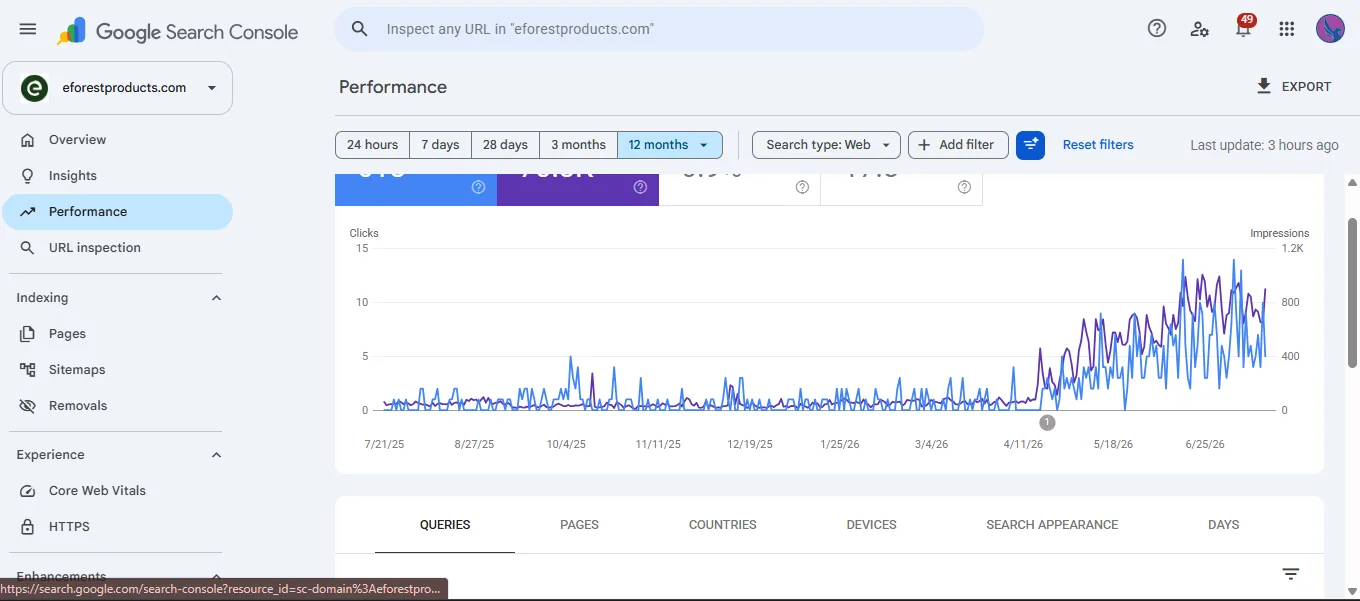
Site launched April 21, 2026. The inflection point is visible. Source: GSC, exported July 23, 2026.
The situation
A 30-year expert. A site that produced almost nothing.
Henry has been a certified consulting forester for over 30 years. He is one of a small number of professionals in the Hudson Valley qualified to write the forest management plans New York requires under the 480-a Forest Tax Law — the program that lets landowners cut their property tax bill on wooded acreage.
He had a website. It loaded fast, it scored well on technical audits, and it produced almost nothing. Every lead came from one channel: a bimonthly direct mail program his partner had been running for eighteen years. Mail worked — but mail only reaches the list you already have, and it goes quiet the moment you stop paying for it. Meanwhile, landowners across six counties were typing "480a forest tax law" and "timber value per acre" into Google every day and finding somebody else.
The baseline was stark:
- Under one organic click per day across the entire site
- Average ranking position of 25 — the bottom of page three
- Rankings for the business name, and essentially nothing else
- A title tag collision causing two service pages to compete against each other
- Deep, valuable expertise locked inside Henry's head and nowhere on the internet
The competitive field was thin. No competitor in the region was running a real content operation. The strongest one had fewer than 60 backlinks. This was an open vertical with a closing window.
What we did
Rebuilt on a faster, cleaner foundation
Migrated from a slow, previously-compromised WordPress install to a modern static architecture (Astro + Tailwind). Every URL was mapped — no page with earned rankings was discarded. Redirects handled in a single controlled layer. Filed a link disavow covering 86 domains left over from a prior security incident.
Built topical authority instead of a brochure
Hub-and-spoke clusters across five verticals: 480-a Forest Tax Law, Land Clearing, Timber Harvesting, Woodlot Management, and Forest Stewardship. Each cluster: a pillar guide, supporting articles, and commercial service pages. Supporting content links up to the pillar; the pillar links out; every article routes toward the service pages. The site went from ~20 pages earning impressions to 344.
Wrote in Henry's voice, not a copywriter's
Every guide reflects thirty years of actual fieldwork — what a shelterwood cut looks like on a real Catskills woodlot, what a 480-a commitment actually obligates a landowner, what a timber stand is worth and why the number moves. Hard rule: no page publishes below a HIGH E-E-A-T rating. No invented dollar figures. No regulatory thresholds without Henry's sign-off. That discipline is why these pages rank against university extension sites and state agencies.
Structured for Google and AI search
Full schema stack — LocalBusiness, BreadcrumbList, Article with author credentials, FAQPage on every guide. FAQ content rendered visible in the DOM (no accordions — AI crawlers don't click). The goal was never just blue links. It was being the source that gets cited when someone asks an AI assistant how 480-a works.
Wired to a CRM that actually follows up
Forms, calls, and chat all route into GoHighLevel with call tracking on the front end to attribute inbound calls to source. Rankings that don't turn into conversations are decoration.
Results — First 90 Days
The site relaunched April 21, 2026. Here is what Search Console recorded in the 90 days that followed, against the nine months before it.
| Metric | Before (9 mo.) | After (90 days) | Change |
|---|---|---|---|
| Organic clicks/day | 0.64 | 4.88 | 7.7× |
| Impressions/day | 51 | 619 | 12.2× |
| Avg. position (all queries) | 25.2 | 15.4 | +9.8 positions |
| Monthly clicks (Mar → Jun) | 23 | 182 | 7.9× |
| Monthly impressions (Mar → Jun) | 1,830 | 21,836 | 11.9× |
| Pages earning impressions | ~20 | 344 | 17× |
| Queries in top 10 | Brand terms only | 114 | — |
The individual page results show where the strategy landed:
| Page | Impressions | Avg. Position |
|---|---|---|
| Timber Value Per Acre (guide) | 9,948 | 6.6 |
| Timber Harvesting Methods (guide) | 4,942 | 9.2 |
| 480-a Forest Tax Law (pillar) | 3,948 | 7.3 |
| Selective Cutting (guide) | 2,296 | 10.3 |
| Shelterwood vs. Clearcutting (guide) | 1,761 | 7.6 |
| Land Clearing Cost Per Acre | 994 | 5.6 |
| Forestry Mulching Cost | 1,014 | 6.8 |
The 480-a pillar page is the one to watch. At the start of the engagement, 480-a terms were ranking in positions 26–35 — invisible. That page now averages position 7.3 and has been seen nearly 4,000 times in three months. It is Henry's highest-margin service and his clearest differentiator, and it is now on page one.
Across the site, 114 queries now rank in the top 10 and 29 rank in the top 3, on a domain that ranked for its own name and little else nine months ago.
Why it worked
- 1
Fixed the structure before scaling the content.
Publishing volume onto a broken architecture just produces more broken pages. Redirects, canonical structure, title collisions, and the spam link profile were resolved before a single new article went live.
- 2
Used the client's actual expertise as the raw material.
There is no shortcut for thirty years in the woods. The content ranks because it is genuinely more useful than what competitors published, not because it hit a word count.
- 3
Built clusters, not pages.
A single page competes alone. A cluster of thirty interlinked pages compounds — every new article strengthens the pillar, and the pillar lifts the service pages that make the phone ring.
- 4
Measured against Search Console, not a dashboard.
Impressions and rankings come from Google directly. No estimated metrics, no vanity reporting.
What's next
Three months in, the informational layer is working and the commercial layer is still ahead of us:
Working in a service business
where nobody can find you online?
That's a fixable problem. The same process — structure first, authority content second, conversion third — is available for your business.
Get Your Audit →