AI Citation for Contractors
Your customers are asking AI
who to call. Are you in the answer?
The short answer: AI engines like ChatGPT, Google AI Overviews, and Perplexity recommend local contractors to buyers right now. They don't rank you by keyword density — they cite businesses with a complete, consistent entity footprint, well-structured content, and third-party authority signals. We build that foundation so when a buyer asks AI for the best contractor in your area, your name is in the answer.
Why this matters right now
45%
of consumers now ask AI to find local businesses
BrightLocal, 2026
1.2%
of local businesses ever get cited by ChatGPT
SOCi, 2026
6→45%
AI local search adoption in a single year
SOCi, 2026
GEO explained
How AI engines decide
which contractor to recommend.
When someone asks ChatGPT "who's the best roofer in Morris County NJ?" — ChatGPT doesn't search Google. It pulls from a training corpus of web content and real-time retrieval sources. It looks for businesses that appear consistently across multiple authoritative sources: directories, review platforms, news mentions, their own website, and cross-referenced entity data.
This is fundamentally different from traditional SEO. You don't rank by stuffing keywords into your homepage. You get cited by having a coherent, verifiable, well-documented presence across the web — what we call an entity foundation. When AI engines cross-reference your business name, address/service area, phone number, categories, and reviews across a dozen authoritative sources and find consistent, structured data, they trust the citation.
GEO (Generative Engine Optimization) is the discipline of building and structuring that foundation. It includes schema markup, content chunking, article clustering, citation seeding, and entity verification — all designed specifically to match how AI engines discover and recommend local businesses.
| Aspect | Traditional SEO | GEO / AEO |
|---|---|---|
| Target | Search result position (blue link) | AI-generated answer (named citation) |
| Primary signal | Keywords + backlinks | Entity authority + structured data |
| User action required | User clicks a search result | AI names your business in the answer |
| Durability | Vulnerable to algorithm updates | Based on entity trust — more stable |
| Citation source | Your own content ranking | 65–93% third-party / earned citations |
| Best for | High-volume informational queries | Local "who is the best X near me" queries |
Content chunking
AI doesn't read long paragraphs.
It extracts short answer blocks.
Traditional web content is written for humans scrolling a page. Paragraphs run 150–300 words. Ideas sprawl across multiple sentences. That's fine for a human reader — but AI systems extract content at the passage level.
When Google AI Overviews, ChatGPT, or Perplexity pulls an answer about your trade from your website, it looks for short, direct, specific answer blocks — ideally 280 characters or fewer — positioned prominently near the top of a section. If those blocks don't exist, the AI skips your content and pulls from a competitor whose content is better structured.
Every page we write follows an answer-first structure: a short, extractable answer block at the top of each section, followed by supporting context. This isn't just good for AI — it's better for users too.
❌ Not AI-extractable
"At our company, we've been providing high-quality HVAC services to the local area for many years. Our team of experienced technicians is dedicated to providing you with the best service possible. We offer a wide range of HVAC solutions including installation, repair, and maintenance. Contact us today to learn more about what we can do for you..."
✓ AI-extractable answer block
"HVAC repair in Morris County NJ typically takes 1–4 hours depending on the issue. We diagnose on the same visit and carry common parts on every truck — so most repairs are completed the same day."
Article clusters for AI authority
One article won't make you an authority.
A cluster of ten will.
AI engines assess topical authority the same way Google does: by the depth and breadth of your content on a subject. A contractor with one generic homepage is not an authority. A contractor with a main service page, 8 related articles, dedicated city pages, and FAQ content structured for extraction — that's what AI engines recognize as a credible source.
We build article clusters around each of your core services. Each article targets a specific question buyers ask — cost guides, how-to explanations, comparison articles, FAQ pages — all structured with answer blocks, all internally linked back to the main service page. Over time, this cluster becomes the content footprint that makes you the obvious citation.
What the entity foundation includes
What we build in the SEND phase
NAP consistency across every directory
Consistent Name, Address/Service Area, and Phone number across every authoritative directory, data aggregator, and platform. Inconsistent NAP is the #1 entity signal that suppresses AI citation — AI engines cross-reference your business data across sources to verify legitimacy.
LocalBusiness + Service schema markup
Organization, LocalBusiness, and Service JSON-LD on every relevant page — machine-readable structured data that tells AI engines exactly who you are, what you do, where you serve, and how you're categorized. Without schema, you're invisible to the structured-data layer AI engines prefer.
FAQPage JSON-LD in static HTML
FAQPage schema with answers rendered in static HTML — readable by AI bots that don't execute JavaScript. Five to seven questions per page, each answer under 280 characters and structured for direct extraction. This is one of the highest-leverage AI citation signals available.
sameAs entity connections
Verified cross-links between your website, Google Business Profile, social profiles, and major directory listings using the schema sameAs property. These connections tell AI engines that all your profiles refer to the same business entity — a critical trust signal for citation.
Passage-level answer content
Service pages rewritten with answer-first structure: short, direct answer blocks (≤280 characters) at the top of each section, followed by supporting context. This is the content format AI systems extract verbatim when assembling citations from your pages.
Citation seeding in authoritative directories
Placement in authoritative local and vertical directories that AI engines use as third-party validation signals. 65–93% of AI-generated local business citations come from third-party sources — not your own website. Directory presence is table stakes for AI visibility.
How the three AI engines differ
ChatGPT, Perplexity, and Google AI Overviews
each cite differently.
Google AI Overviews
What it does: Appears above the Map Pack for many local contractor searches. Pulls from Google's index using passage-level extraction.
Citation signals: Schema markup, entity data, passage-level answer blocks on your website. GBP completeness and review sentiment are confirmed co-signals.
Why it matters: This is the highest-urgency target for contractors because it appears above the Map Pack — your content can capture a buyer's attention before they even see your listing.
ChatGPT (with Browse)
What it does: When users ask for local contractor recommendations, ChatGPT browses web sources and pulls businesses with strong entity presence.
Citation signals: Third-party directory citations, review platform presence, consistent NAP, and website content with identifiable entity data. Schema markup accelerates recognition.
Why it matters: ChatGPT is increasingly used for local recommendations. Being cited here means your business name enters a buyer's consideration before they ever open Google.
Perplexity
What it does: A search-AI hybrid that assembles cited answers from web sources. Perplexity citations appear as footnoted sources — high credibility for the reader.
Citation signals: Well-structured content pages with clear answer blocks, authoritative third-party directory presence, and entity data that matches across sources.
Why it matters: Perplexity users are typically high-intent researchers — exactly the buyers who are comparing contractors carefully and about to make a decision.
Live proof
ChatGPT names a client —
without being asked to.
Cornerstone Services, Inc. (a direct mail client) is cited by ChatGPT as the top result for "direct mail company, Hudson Valley, New York" — unprompted, with no paid placement. This is the result of entity foundation work, not rankings or ads.
Third-party, verifiable AI citation. The same result we build for contractors in their markets.
Read the full case study →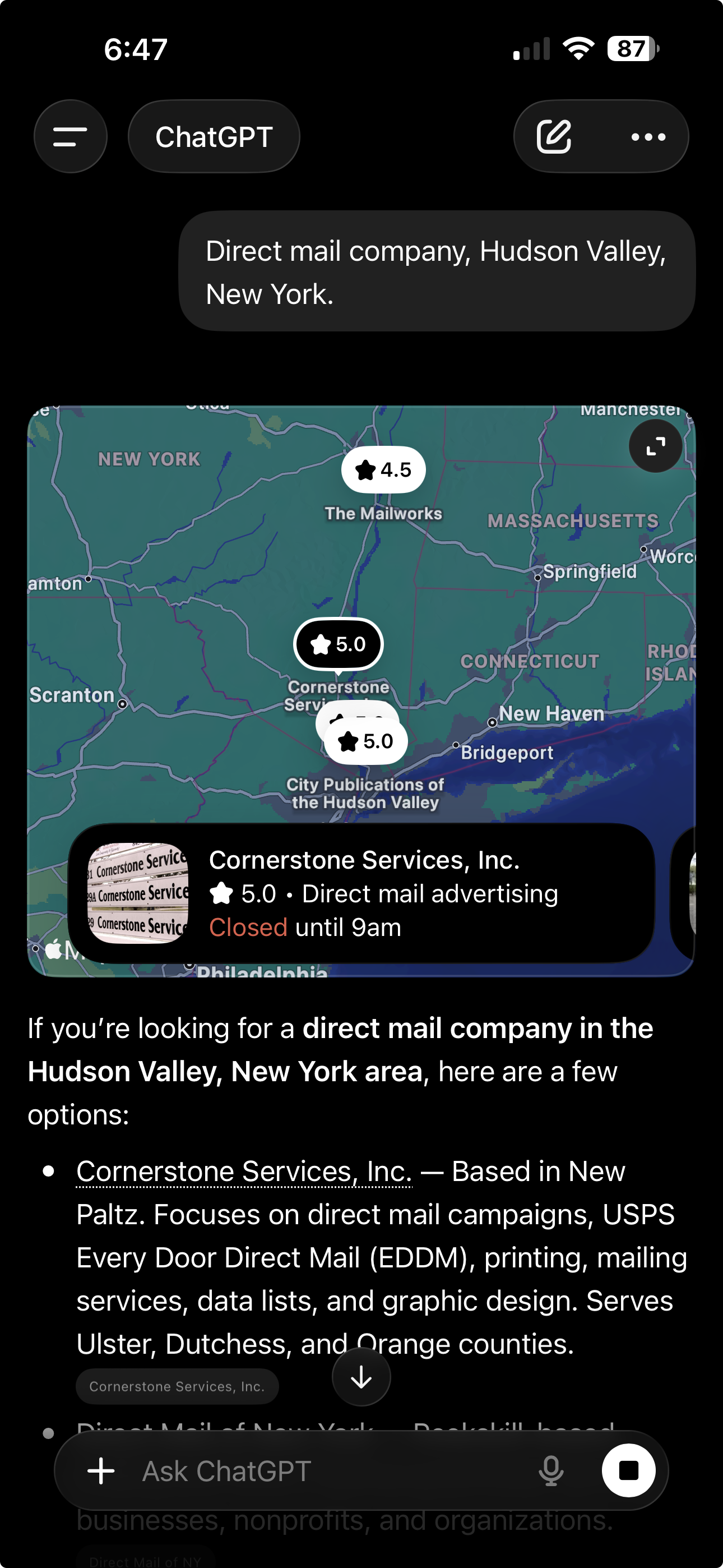

Bryan T. Collins
Local SEO & GEO Strategist · Launch with Bryan LLC
Bryan T. Collins has spent 30+ years in digital marketing helping local businesses get found online. He served as a U.S. Marine Corps communications specialist, is a published author, and has built and ranked websites for local service businesses across the country. His work focuses on GEO (Generative Engine Optimization) and local SEO — the two disciplines that determine whether your business gets found when buyers search, or ask AI, for contractors in your area.
Full bio, credentials & verified profiles →FAQs
Common questions about GEO & AI citation
What is GEO (Generative Engine Optimization)?
GEO is structuring your business's entity data, content, and schema markup so AI systems like ChatGPT, Google AI Overviews, and Gemini select you when generating answers. Unlike traditional SEO that targets ranked URLs, GEO targets AI-generated responses where your business is named directly.
How do AI engines decide which local businesses to cite?
AI engines pull from three sources: your structured entity data (schema markup, NAP consistency), your content structure (short answer blocks they can extract verbatim), and third-party citations (directories, reviews, press mentions). 65–93% of AI citations come from third-party sources — not your own website.
What is content chunking and why does it matter for AI citation?
Content chunking means writing short, direct answer passages of 280 characters or fewer at the top of each content section. AI systems extract these passage-level blocks verbatim when assembling citations. Long paragraphs without clear answer structure get ignored. Well-chunked content gets quoted.
What is a content cluster and how does it help AI visibility?
A content cluster is a hub page (your main service page) surrounded by spoke articles on related subtopics — all linking back to the hub. A cluster of 6–10 articles on the same topic signals topical authority to AI engines. Businesses with deep content clusters get cited as experts, not just businesses.
What is an entity foundation and why does it matter?
An entity foundation is a consistent, verified business identity across the web: the same business name, address/service area, phone number, and description on every platform. Schema markup connecting your website to your GBP. sameAs links between all your profiles. AI engines use this cross-referenced data to verify your business is legitimate before citing it.
What is AEO (Answer Engine Optimization)?
AEO optimizes content to be extracted and cited by AI answer engines — tools people use instead of clicking search results. A business that appears in AI answers gains visibility without requiring the user to visit a search results page at all. AEO is GEO applied specifically to question-based queries.
How is GEO different from traditional local SEO?
Traditional SEO wins ranked positions in a list of blue links. GEO wins named citations inside AI-generated answers. Both matter, but AI citations are more durable — they're based on entity authority, not keyword density or backlink counts, and they don't disappear when an algorithm updates.
How long does it take to get cited by AI?
Entity foundation work typically shows AI citation signals within 60–120 days, depending on your existing online footprint, competition, and how much structured data work needs to be done. Third-party citation seeding — directory listings, press, authoritative mentions — accelerates this significantly.
Can any local contractor get cited by ChatGPT?
Yes. Local service businesses are a primary target for AI citation because users frequently ask AI tools for local recommendations like "who's the best roofer in [city]?" The contractors with complete, consistent, structured entity data across the web win those citations.
What do you actually build in the entity foundation phase?
NAP consistency across all directories and aggregators, LocalBusiness and Service schema markup on every page, FAQPage JSON-LD with static-HTML answers, sameAs connections between website and all profiles, citation seeding in authoritative local and vertical directories, and passage-level answer content on every key service page.
Complete the system with Launch with Bryan
Ready to get cited by AI?
Start with a free call. We'll check your current AI citation status across ChatGPT, Perplexity, and Google AI Overviews — and show you exactly what it takes to get named.
Book a free call