Local SEO for Contractors
Your competitors are getting calls
from Google. You should be too.
The short answer: Local SEO for contractors means owning the top 3 positions in Google Maps and the AI Overviews that now appear above them. Those positions require a complete Google Business Profile, a structured website with service+location pages, a steady flow of real customer reviews, and content that AI engines can extract and cite. We build all of it.
The basics
What is local SEO — and why do
contractors need it more than anyone?
When a homeowner in your area types "roofer near me" or "HVAC repair [city name]" into Google, one of two things happens: your business appears in the top 3 results, or a competitor gets the call. There is no middle ground — buyers rarely scroll past the first three Map Pack listings.
Local SEO is everything that determines which 3 businesses appear in that Map Pack. It includes your Google Business Profile (the single most important local ranking signal), your website's structure and page speed, the number and recency of your Google reviews, the consistency of your business information across the web, and the depth of content on your site about the specific services you offer in the specific cities you serve.
Unlike paid Google Ads that stop the moment you stop paying, local SEO rankings compound over time. A contractor who owns the Map Pack in their market today will continue to book jobs from those rankings next year and the year after — without paying per click.
70%+
of local service clicks go to the top 3 Map Pack positions
BrightLocal, 2025
88%
of local searches on mobile result in a call or visit within 24 hours
Google Consumer Insights
56%
of local businesses have not even claimed their Google Business Profile
BrightLocal, 2025
Why most contractor websites fail at local SEO
Wix, Squarespace, and GoDaddy
are not built to rank.
Template builders are designed to be easy to use — not to win local search. A contractor running a Wix site is competing with a hand behind their back. Here's specifically why:
Slow on mobile
Google's Core Web Vitals score is a ranking factor. Wix and similar builders load slowly on mobile because they serve heavy JavaScript frameworks that weren't designed for speed. A slow site ranks below a fast site — even if every other signal is equal. Most contractor searches happen on a phone, on a job site, by a homeowner who's ready to hire right now.
No service+location page structure
A template site typically has one "Services" page listing everything the business does. That gives Google one generic page to rank against every possible local search. A properly architected site has a dedicated page for each service in each city — "deck builder Montville NJ," "deck repair Randolph NJ," "pergola installation Morris County NJ." Each page is a separate target for a separate search query.
No schema markup
Schema markup is machine-readable structured data that tells Google exactly what your business does, where it operates, what reviews say about it, and how your services are categorized. Template builders either omit schema entirely or generate generic markup that doesn't help local rankings. Custom-coded sites include LocalBusiness, Service, FAQPage, and BreadcrumbList schema on every relevant page.
Thin content Google won't rank
Template sites encourage short, visual layouts — big photos, minimal text. Google requires substantive content to rank a page for competitive local keywords. A contractor page on a template site typically has 100–200 words. A rankable service+location page has 600–1,200 words of specific, helpful content about that service in that area.
No content cluster architecture
Ranking for competitive terms like "roofing contractor [city]" requires topical authority — Google needs to see that your site is a comprehensive resource about roofing, not just a brochure. Template sites don't support the hub-and-spoke content architecture that builds this authority. Custom-built sites do.
This is exactly what we fix.
A custom-coded contractor site gives Google a properly structured, fast, schema-marked, content-rich target — instead of a generic brochure that blends into the crowd.
The Map Pack explained
Three spots. One city. The whole game.
When a buyer searches "plumber near me" or "HVAC contractor [city]," Google shows a local map with 3 business listings before any website results. These 3 positions — called the Local 3-Pack or Map Pack — receive 70%+ of all clicks for that search. Here's how Google decides who fills them.
🎯
Relevance
How closely your Google Business Profile category, description, and services match what the buyer searched. A roofing contractor with properly set primary and secondary categories beats one with a generic "Contractor" category every time.
📍
Distance
How close your business location or service area is to the searcher. Proximity is a factor you can't fully override — but accurate service area settings in your GBP ensure Google knows exactly where you work.
⭐
Prominence
How well-known and trusted Google believes your business is — based on review count, recency, and average rating; the number of backlinks to your site; citation consistency; and overall web presence.
The real leverage point:
Most contractors can't control distance. But relevance and prominence are entirely engineerable. A complete GBP with the right categories, an active review generation system, a website that reinforces your local authority, and consistent citations across the web — these are the levers that move you from position 7 to position 1.
Google Business Profile
Your GBP is the most important
local ranking asset you own.
Google Business Profile (formerly Google My Business) is the free listing that powers your Map Pack ranking, your Google Maps presence, and the knowledge panel that appears when someone searches your business name directly. It is not optional. An incomplete or unoptimized GBP is the single most common reason contractors lose Map Pack rankings to competitors with inferior work.
✓ Primary and secondary categories
Categories tell Google what business type you are. The wrong primary category is the #1 GBP ranking mistake contractors make — "General Contractor" will not rank for roofing, plumbing, or HVAC queries.
✓ Service area setup
Service-area businesses (contractors who go to the customer) should hide the physical address and set accurate service area coverage. Incorrect service area setup limits your geographic ranking footprint.
✓ Service menu
Every specific service you offer should be listed in the GBP service menu with descriptions. This directly feeds Google's relevance matching for specific search queries.
✓ Weekly posts
Regular GBP posts signal that your business is active. Google factors posting recency into local rankings. Most contractors never post — which means it's an easy differentiator.
✓ Photo library
Real job-site photos outperform stock photography. Google surfaces GBP photos in Maps results. Businesses with 10+ photos average significantly higher click-through rates than those with 1–2.
✓ Q&A seeding
The Q&A section on your GBP is publicly editable. Seeding it with answered questions about your services preempts buyer objections and adds keyword-relevant content to your profile.
✓ Review response
Responding to every review — positive or negative — signals engagement and is a known GBP ranking factor. Most contractors ignore this. We build a response cadence into the system.
✓ Attributes & accessibility
GBP attributes (veteran-owned, women-owned, family business, languages spoken, service guarantees) surface in filtered Map Pack searches and add relevance signals.
Review strategy
12 reviews vs. 80 reviews.
You already know who wins.
In most contractor trades, a business with 80+ Google reviews outranks a business with 12 reviews — regardless of how much better the 12-review contractor's work actually is. Google uses review count and recency as trust and prominence signals. AI systems surface review sentiment as a verification layer. Buyers use star count as a shortcut for quality.
The fix is a systematic review generation process — not asking customers when you remember, but triggering an automated request at the right moment (job completion) and following up once. Every real customer gets asked. Most businesses only ask a fraction of theirs.
Important: We help you ask every real customer at the right time and follow up automatically. We never guarantee star ratings, manufacture reviews, offer incentives for reviews, or cherry-pick who gets asked — all of which violate Google's policies.
Review count signal
More reviews = stronger prominence signal. Minimum 40–50 reviews to compete in most markets.
Review recency signal
Google weights recent reviews more heavily. A business with 5 reviews last month beats one with 80 from 3 years ago.
Rating signal
Anything below 4.2 suppresses click-through. 4.5+ is the threshold to consistently win phone calls.
Response rate signal
Responding to reviews is a confirmed Google ranking factor. Response rate below 50% signals disengagement.
Service+location pages
One generic website can't rank
for 200 specific local searches.
When a homeowner searches "deck builder Parsippany NJ" — Google is looking for a page specifically about building decks in Parsippany, NJ. If your website has one generic "Services" page that lists everything you do, Google has nothing specific to show that buyer. A competitor with a dedicated page wins the click.
A service+location page architecture maps each of your core services to each of your service cities. A roofing contractor serving 15 cities with 6 services has the potential for 90 rankable pages — each targeting a specific buyer intent, each capturing traffic that a single generic site can't reach.
Example architecture for a roofing contractor in Morris County, NJ:
Each page: unique content, LocalBusiness schema, FAQs, internal links to main service hub
Content clustering
Google rewards expertise.
Content clusters prove you have it.
A content cluster is a hub-and-spoke content architecture. The hub is your main service page — say, "Roofing Contractor NJ." The spokes are related articles: "How long does a roof last?", "How much does roof replacement cost in NJ?", "Signs you need a new roof," "How to choose a roofing contractor," "Asphalt vs. metal roofing comparison."
All spoke articles link back to the hub page. The hub links out to spoke articles. This internal linking structure tells Google that your site isn't just a brochure — you're a comprehensive resource on this topic. Google calls this topical authority, and it's one of the primary factors that separates page-1 rankings from page-5 obscurity.
Content clusters also feed AI visibility. When ChatGPT or Google AI Overviews encounter a business with 8 in-depth articles about HVAC repair in a specific market, they're far more likely to cite that business as an authority than one with a single homepage.
Hub + Spoke: Roofing Contractor
All spoke articles link back to the hub
Where clicks come from
Three channels. One coordinated strategy.
01
Google AI Overviews
AI-generated summaries now appear above the Map Pack for many local queries. Contractors whose content is structured in passage-level answer blocks get cited inside these overviews, capturing brand visibility before the buyer even sees the Map Pack.
Key signals
Entity authority, schema, answer-block content
02
Local Map Pack
The top 3 map results that appear for "near me" and location-specific searches. Capturing a top-3 position means winning 70%+ of clicks for those queries. This is where most contractor jobs come from in local search.
Key signals
GBP completeness, reviews, proximity, site authority
03
Organic results
Service+location pages that rank for specific trade + city searches. These capture the buyer who doesn't click the Map Pack — who scrolls to find the contractor with the most informative, credible-looking website.
Key signals
Dedicated service pages, content clusters, on-page SEO
What we build
Specific deliverables —
not vague "SEO work."
Every engagement starts with a gap audit of your current GBP, website, reviews, and competitor positions. Then we build from the highest-leverage gaps first.
✓ Google Business Profile build & optimization
Complete GBP setup or audit — verified categories, service areas, business hours, photos, weekly posts, Q&A seeding, and review response strategy. GBP is the single highest-leverage local ranking signal for contractors.
✓ Review generation system
Automated sequences that ask every real customer at the right time and follow up once. The goal is a consistent monthly flow of new reviews — not a one-time push. More reviews, higher recency, better rankings.
✓ Service+location page architecture
Dedicated pages for each service and city combination you want to rank for. Each page targets one specific search query with unique content, schema markup, and internal links back to your main service page.
✓ Content cluster build-out
Hub-and-spoke article clusters that build topical authority around your core services. Related articles (cost guides, how-tos, FAQs) link back to service pages, signaling depth of expertise to Google.
✓ Competitor gap analysis
Side-by-side audit of the top 3 Map Pack competitors — what reviews, GBP signals, service pages, and content they have that you don't. The priority sequence to close the gap is built from this analysis.
✓ AI Overview targeting
Content structured in ≤300-character passage-level answer blocks that Google AI Overviews can extract directly. Your pages contribute to AI citations — not just rank beneath them.
✓ Citation consistency audit
NAP (name, address/service area, phone) verified and corrected across every major directory and data aggregator. Inconsistent citations suppress local rankings and confuse AI engines that cross-reference your business data.
✓ Monthly visibility reporting
Google Search Console, GBP Insights, and ranking data translated into plain-language reports. You see what moved, what's next, and what's producing booked jobs — not vanity metrics.
Live proof
ChatGPT names a client —
without being asked to.
Cornerstone Services, Inc. is cited by ChatGPT as the top result for "direct mail company, Hudson Valley, New York" — unprompted, with no paid placement. The result of entity foundation work, complete GBP, and content architecture — not ads.
Read the case study →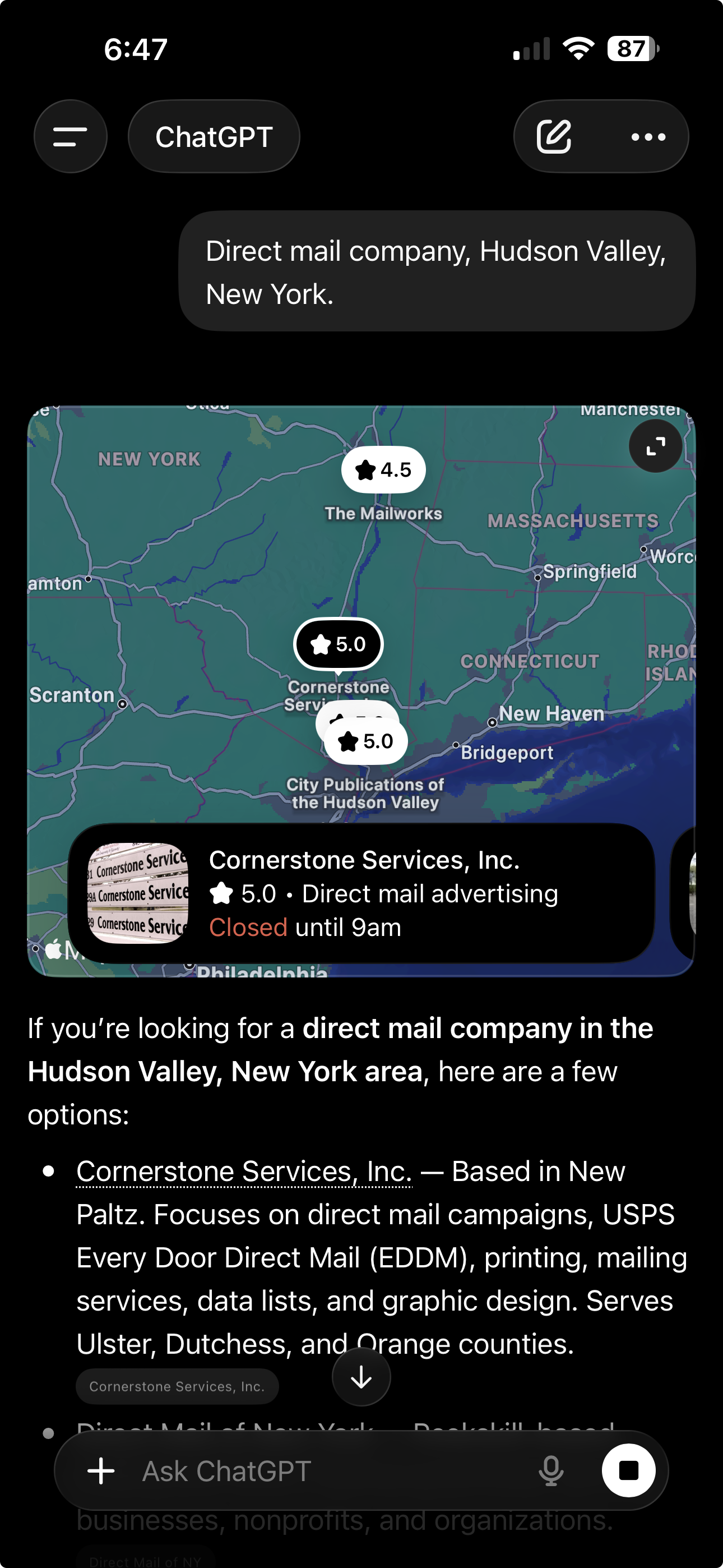

Bryan T. Collins
Local SEO & GEO Strategist · Launch with Bryan LLC
Bryan T. Collins has spent 30+ years in digital marketing helping local businesses get found online. He served as a U.S. Marine Corps communications specialist, is a published author, and has built and ranked websites for local service businesses across the country. His work focuses on GEO (Generative Engine Optimization) and local SEO — the two disciplines that determine whether your business gets found when buyers search, or ask AI, for contractors in your area.
Full bio, credentials & verified profiles →FAQs
Common questions about local SEO for contractors
What is local SEO for contractors?
Local SEO is optimizing your online presence so your contracting business appears when local buyers search Google for your trade in your service area. It covers your Google Business Profile, website structure, local service pages, reviews, and citation consistency across the web.
What is the Google Map Pack and why does it matter so much?
The Map Pack is the block of 3 local businesses Google shows with a map at the top of local search results. Those 3 positions capture 70%+ of all clicks for local service searches. Position 4 is effectively invisible to buyers who are ready to hire right now.
Why don't Wix or template websites rank well locally?
Template sites built on Wix, Squarespace, or GoDaddy load slowly on mobile, lack dedicated service+location pages, use no schema markup, and have no content depth. Google's local algorithm rewards specificity — a generic site with one "Services" page can't compete with a structured site built page-by-page for each trade and city.
How does Google decide who ranks in the Map Pack?
Google uses three signals: Relevance (does your GBP match what was searched?), Distance (is your business or service area near the searcher?), and Prominence (how trusted and well-known is your business online based on reviews and web presence?). All three must be optimized simultaneously.
How many Google reviews do I need to rank?
In most contractor trades, businesses with 50+ reviews consistently outrank those with fewer. Recency matters as much as count — Google weights new reviews heavily as a signal of an active, legitimate business. A steady monthly flow beats a one-time push.
What are service+location pages and why do contractors need them?
A service+location page targets one specific service in one specific city — like "roof replacement Morris County NJ" or "deck builder Princeton NJ." Each page gives Google a precise target to rank for one query. Without these, your site gives Google one generic page to match against hundreds of specific buyer searches.
What is content clustering in local SEO?
Content clustering groups related articles around a central service page to build topical authority. A cluster for "roof replacement" might include articles on roofing materials, cost guides, signs you need a new roof, and how to choose a contractor — all linking back to the core service page, increasing that page's authority in Google's eyes.
How long does it take to rank in the Map Pack?
With a complete GBP, a properly structured site, and active review generation, most contractors see Map Pack movement in 60–90 days. Highly competitive markets may take 4–6 months for consistent top-3 placement. The results compound — unlike paid ads, rankings don't disappear when you stop paying.
Do Google AI Overviews affect local contractor searches?
Yes. Google AI Overviews now appear above the Map Pack for many local queries. Contractors whose content is structured in short, extractable answer blocks — and whose entity data is complete — get cited inside these overviews, capturing visibility even when buyers don't click a traditional search result.
What's the difference between local SEO and regular SEO?
Traditional SEO targets national keyword rankings using content and backlinks. Local SEO targets geographic searches using your Google Business Profile, local citations, proximity signals, reviews, and location-specific service pages. For contractors, local SEO almost always drives more booked jobs — because the buyer is nearby and ready to hire today.
Complete the system with Launch with Bryan
Ready to own the Map Pack in your market?
Start with a free call. We'll audit your current GBP, website, and competitor position — and tell you exactly what it takes to rank #1 in your area.
Book a free call